Election Day brought several notable changes to Tennessee’s political landscape, including a new governor and new faces in the General Assembly and congressional delegation. As results are finalized and leadership decisions take shape, AIA Tennessee is watching what these transitions could mean for architects and the communities we serve. Here’s a look at the key outcomes from the election.
Governor’s Race
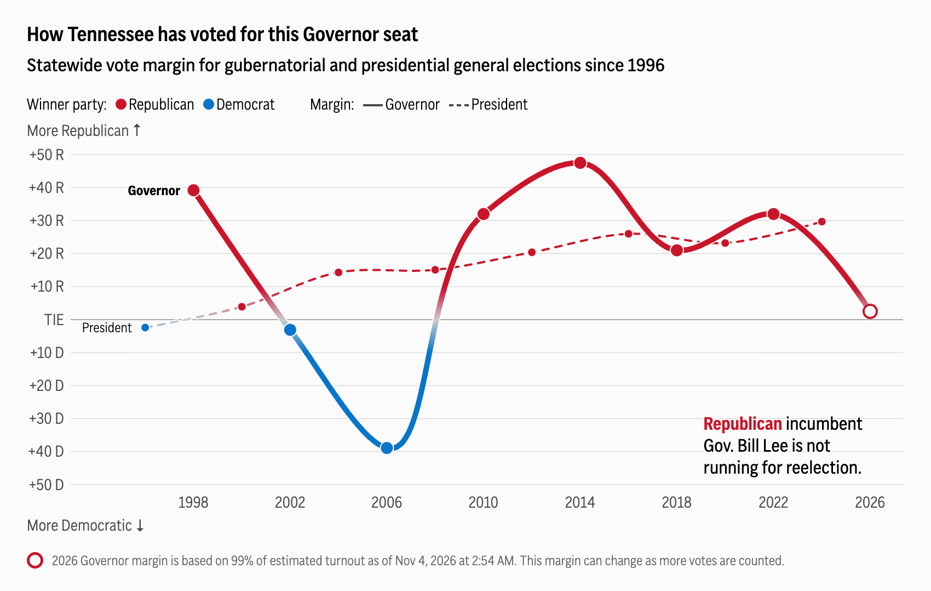
Republican Marsha Blackburn was elected Tennessee’s next governor, succeeding term-limited Gov. Bill Lee and becoming the first woman to lead the state.
Unofficial results show a margin of approximately 2.6 percentage points. A substantially closer contest than Tennessee’s recent gubernatorial elections. Stronger Democratic support and a significant share of votes for independent candidates contributed to the competitive outcome.
Republican U.S. Sen. Bill Hagerty also secured reelection, defeating Democrat Marquita Bradshaw by approximately 12 percentage points, according to unofficial results.
Blackburn’s transition to the governor’s office will create a vacancy in the U.S. Senate. As governor, she will appoint an interim successor to serve until a special election in 2028.
News of Interest: Tennessee Governor-elect Marsha Blackburn discusses transition
Gov. Bill Lee and Governor-Elect Marsha Blackburn spoke to Tennesseans at a joint press conference Wednesday, November 4, 2026.
Congressional Races
Unofficial results show Democrat Victoria Broderick narrowly ahead of longtime Republican incumbent Scott DesJarlais in Tennessee’s 4th Congressional District by fewer than 300 votes, setting the stage for a significant upset.
In the newly redrawn 9th Congressional District, Republican State Sen. Brent Taylor holds a narrow lead over Democrat Justin Pearson, according to unofficial results.
Several other Republican-leaning districts also saw competitive races though Republican candidates ultimately prevailed.
If these results hold, Tennessee’s U.S. House delegation will remain eight Republicans and one Democrat, with the Democratic seat shifting from District 9 to District 4.
TN State Senate
Republicans retained all of their Senate seats maintaining a 27–6 majority remaining five seats above the 22 seats needed for a two-thirds supermajority.
Attention now turns to the closely contested race to succeed retiring Lt. Gov. Randy McNally. Senate Majority Leader Jack Johnson and Commerce Committee Chairman Paul Bailey are seeking the Republican nomination with the caucus vote scheduled for November 10. Given the Republican majority, that vote is expected to determine the Senate’s next speaker, who also serves as lieutenant governor. The outcome will help shape committee leadership, legislative priorities, and the Senate’s working relationship with the incoming Blackburn administration.
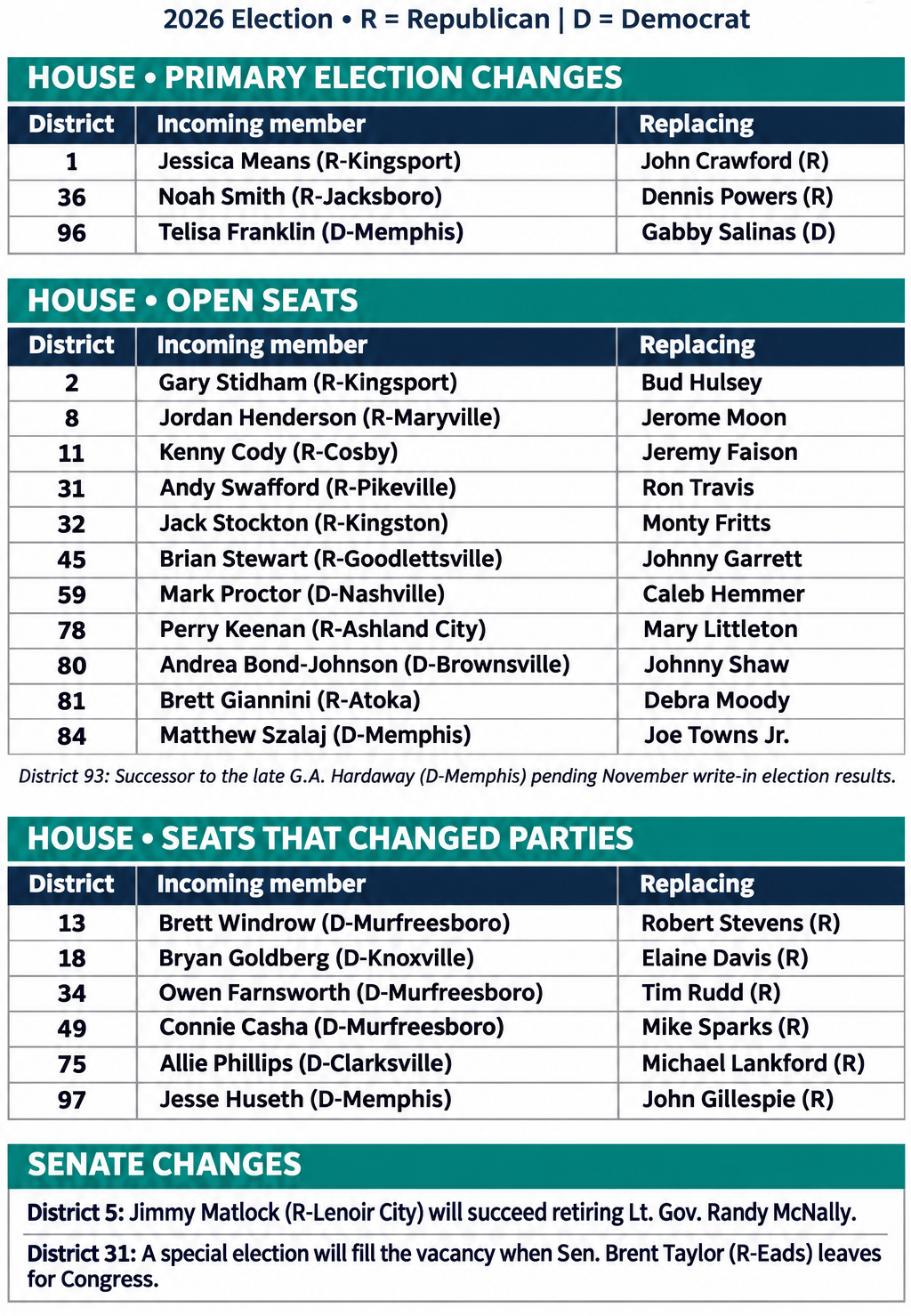
Brent Taylor’s anticipated transition to Congress will also create a Senate vacancy, adding another transition as lawmakers prepare for the 2027 session.
TN House of Representatives
Democrats flipped six Republican-held seats in the Tennessee House, narrowing the Republican advantage while leaving its supermajority intact.
The projected makeup is 69 Republicans and 30 Democrats. The Democratic gains and closer margins in several other races were particularly notable in the growing Murfreesboro, Clarksville, and Knoxville areas.
New Members in TN General Assembly
The House will welcome 21 new members. 10 Republicans and 11 Democrats. Its largest freshman class since 2019. Two new Republican members will also join the Senate.
Sources:
· TN Secretary of State Election Returns
· AP News summary and analysis tools detailing TN election results
(Excerpt below showing partisan performance in gubernatorial contests compared to presidential margin)