
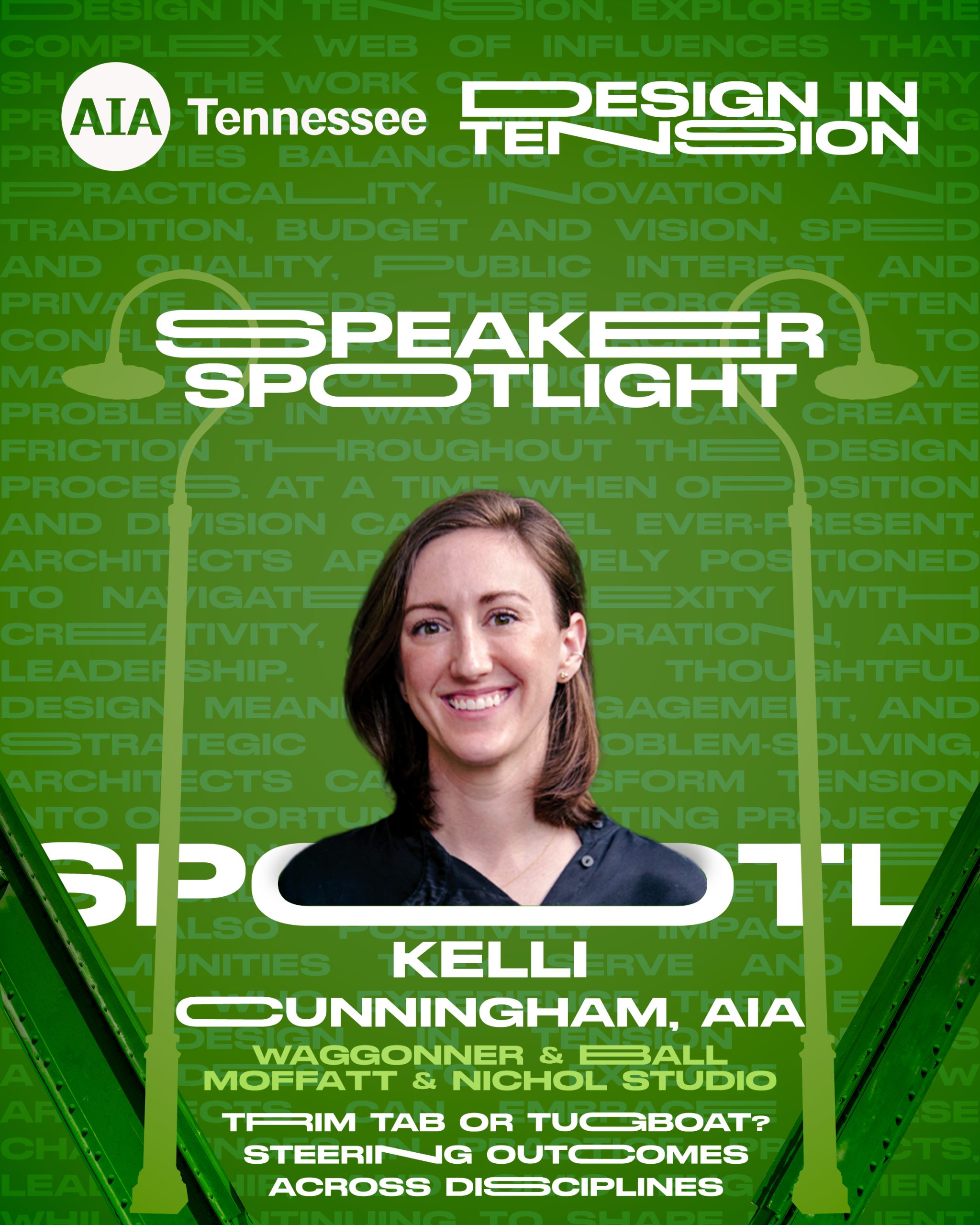
We’re excited to welcome Kelli Cunningham, AIA, ASLA, PLA, as a keynote speaker at the 2026 AIA Tennessee Conference on Architecture on Friday, August 14.
As a Principal and Operations Director at Waggonner & Ball, Kelli leads resilience-focused work that bridges architecture, landscape architecture, and urban systems to help coastal communities adapt to changing environmental conditions. From nationally recognized resilience initiatives to innovative nature-based infrastructure projects, her work demonstrates how design can connect disciplines, scales, and communities to create lasting impact. Her perspective on systems thinking, water, and adaptive environments promises to inspire meaningful conversations about the future of design.
In anticipation of her conference presentation, titled “Trim Tab or Tugboat? Steering Outcomes Across Disciplines,” Kelli shares her perspective on systems thinking, adaptive leadership, and the role designers play in shaping change.
Design often requires balancing competing priorities. What is a tension in your work that you continue to wrestle with, and what has it taught you as a designer?
One tension I continually wrestle with is knowing when to lead decisively and when to influence more subtly. In complex, interdisciplinary work, especially at the scale of infrastructure and environmental systems, there are moments when pushing too hard can fracture alignment, but stepping back too far can dilute critical outcomes. That tension has taught me that design leadership isn’t fixed; it’s situational. The most effective designers learn to read the system they’re working within and adjust their role, to keep the work moving toward outcomes that truly matter.
Can you recall a project, experience, or moment that fundamentally challenged the way you think about design? How has that shift stayed with you?
Working on projects at the watershed scale fundamentally shifted how I think about design. Early in my career, I focused more on the precision of individual elements, details, materials, and form. But engaging with larger environmental systems made it clear that those details are most meaningful in relation to the flows and forces that shape them, especially water. That shift has stayed with me as a constant reminder that as design operates across scales our responsibility extends beyond the site to the broader systems that influence long-term performance, resilience, and community impact.
What is something outside of architecture that continually informs your work?
I’m consistently influenced by systems thinking, particularly from ecology and hydrology. These disciplines frame problems not as isolated conditions but as interconnected flows and feedback loops. That perspective translates directly into design: understanding how water moves, how systems adapt, and how small interventions can have cascading effects. It reinforces the idea that architecture isn’t just about objects. It’s about relationships, behaviors, and long-term dynamics.
What is a question you hope attendees leave your session asking themselves?
How am I engaging with each project most effectively? Am I exerting visible force or making smaller, strategic adjustments that shift the entire system? Am I choosing the right approach for the problem in front of me?
As you prepare to visit Chattanooga, is there an aspect of the environment, design culture, or history you’re especially interested in experiencing or learning more about?
I’m especially interested in Chattanooga’s relationship to its river system—how the Tennessee River has shaped the city’s development, infrastructure, and public space over time. I’m curious to see how the city has navigated its dynamic edge condition, balancing access, ecology, economy, and risk. There’s always something to learn from places where natural systems are not just a backdrop, but an active driver of design decisions.